Stop Optimizing the Wrong Things: Lessons From Building High-Performance Backend Systems
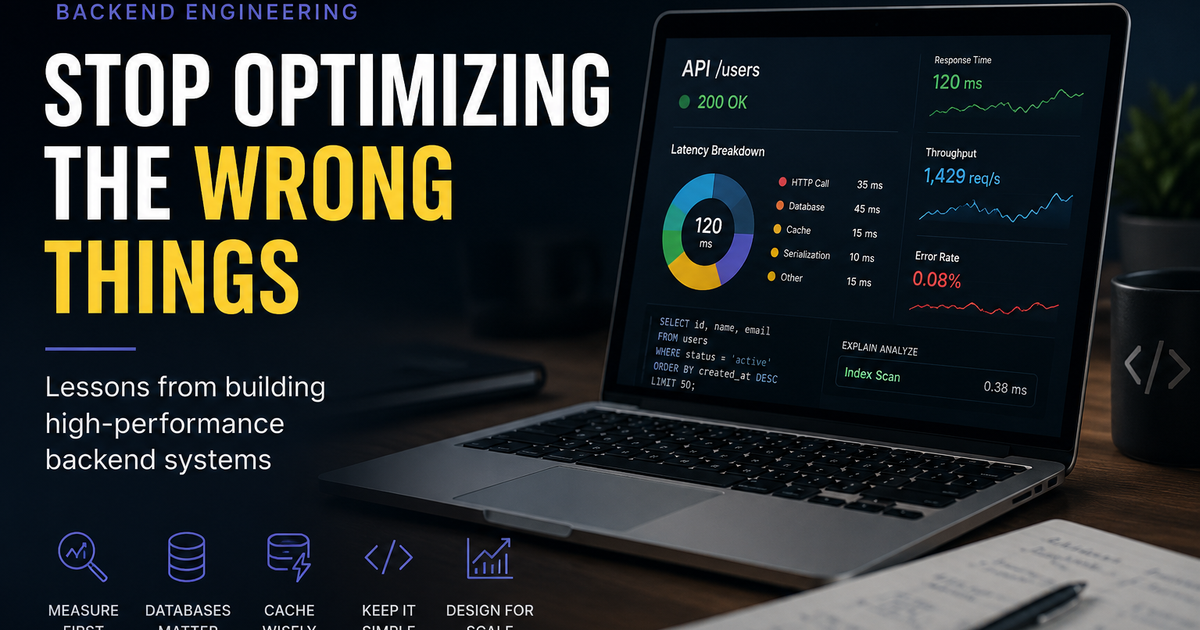
When developers talk about backend performance, the conversation usually jumps straight to databases, caching, Kubernetes, or distributed systems.
In reality, most backend systems aren't slow because they're missing Redis or because PostgreSQL can't keep up. They're slow because of hundreds of tiny engineering decisions that compound over time.
Over the past few years, I've worked on backend systems ranging from enterprise banking software to AI-powered SaaS platforms. One lesson keeps repeating itself:
Performance is rarely about one brilliant optimization. It's about eliminating thousands of small inefficiencies.
This post covers the principles that consistently delivered the biggest improvements.
1. Measure Before You Optimize
One of the most common engineering mistakes is optimizing code that isn't actually the bottleneck.
I've seen teams spend weeks rewriting algorithms while a single external API call consumed 80% of the request latency.
Before touching any code, answer questions like:
- Where is the request spending its time?
- Is the bottleneck CPU, memory, disk, or network?
- Is latency coming from your service or another dependency?
- Is the issue affecting all users or just specific workloads?
Good profiling often saves far more time than good coding.
2. The Database Is Usually Innocent
Developers love blaming databases.
In practice, databases are incredibly optimized software.
The real issues are usually things like:
- N+1 queries
- Missing indexes
- Fetching entire tables instead of required columns
- Repeated identical queries
- Inefficient joins
- Poor schema design
For example:
Instead of:
SELECT *
FROM Orders;
Use:
SELECT OrderId,
CustomerId,
Total
FROM Orders
WHERE CustomerId = ?
Reducing unnecessary data movement often produces larger gains than switching database technologies.
3. Every Network Call Has a Cost
Local function calls are measured in nanoseconds.
Network calls are measured in milliseconds.
That difference is enormous.
A service making five sequential HTTP requests might spend hundreds of milliseconds waiting—even if each downstream service is fast.
Whenever possible:
- Batch requests
- Execute independent calls concurrently
- Cache immutable data
- Reduce chatty APIs
Latency compounds surprisingly quickly.
4. Caching Is Powerful—but Dangerous
Caching is often presented as a silver bullet.
It isn't.
Every cache introduces difficult questions:
- When does data expire?
- Who invalidates it?
- Can stale data break the application?
- How much memory should be allocated?
A slow but correct system is almost always preferable to a fast system serving incorrect data.
Cache only after identifying repeated expensive operations.
5. Simplicity Scales Better Than Cleverness
Engineers sometimes chase elegant abstractions that only the original author understands.
Six months later, every modification becomes risky.
Simple code has advantages:
- Easier debugging
- Faster onboarding
- Lower maintenance cost
- Better reliability
Future-you is another developer.
Write code they can understand.
6. Observability Is a Feature
Logs are useful.
Metrics are useful.
Distributed tracing is useful.
Together, they're transformative.
Without observability you're effectively debugging blind.
Every production service should expose enough information to answer:
- What failed?
- Why did it fail?
- How often does it fail?
- Which users are affected?
- How long has it been happening?
Production incidents become dramatically easier when these answers are available immediately.
7. Concurrency Doesn't Automatically Mean Performance
Adding threads, goroutines, async tasks, or workers won't magically speed things up.
Concurrency introduces:
- Race conditions
- Deadlocks
- Lock contention
- Scheduling overhead
- Increased complexity
Parallelism should solve a measured bottleneck—not create new ones.
Sometimes a straightforward sequential implementation is both faster and easier to maintain.
8. The Biggest Wins Often Come From Architecture
Micro-optimizations matter.
Architecture matters more.
Questions worth asking include:
- Does this service actually need to be distributed?
- Can this workflow be asynchronous?
- Should expensive work happen during requests?
- Can we process data in batches?
- Are we storing information in the right format?
A single architectural improvement can outperform dozens of low-level optimizations.
9. Performance Is a Product Feature
Users rarely care which framework you're using.
They notice:
- Fast page loads
- Responsive search
- Reliable APIs
- Predictable latency
- Consistent uptime
Performance directly affects user trust.
Every unnecessary delay is friction.
Final Thoughts
Backend engineering isn't about writing the most sophisticated code.
It's about building systems that remain fast, reliable, and maintainable long after the initial release.
The engineers I admire most aren't the ones who know every distributed systems paper by heart. They're the ones who consistently build software that's easy to operate, easy to debug, and easy to improve.
Technology changes every year.
Solid engineering principles don't.
If you take away one lesson from this post, let it be this:
Measure first. Simplify aggressively. Optimize where it actually matters.